

OvertheCounter
    Twitter LinkedIn
    • Email Newsletters
    • Magazine Subscriptions
    • About Us
    • Advertise
    • Contact Us
    Twitter LinkedIn
    CPD Log-In
    OvertheCounter
    • News
      • Dairy / Beef
      • Sheep
      • Pigs / Poultry
      • Equine
      • Companion
      • Retail
      • Training
    • Magazines
      1. May 2026
      2. March 2026
      3. January 2026
      4. November 2025
      5. September 2025
      6. July 2025
      7. May 2025
      Featured

      Over the Counter – May 2026

      By Simon KingMay 18, 2026
      Recent

      Over the Counter – May 2026

      May 18, 2026

      Over the Counter – March 2026

      March 17, 2026

      Over the Counter – January 2026

      January 12, 2026
    • CPD Training
      • AMTRA CPD Modules
        • Frontline Academy
        • Companion Animal CPD Modules
        • Equine CPD modules
        • Livestock CPD Modules
        • Poultry CPD Modules
        • Are you a Gold Standard SQP?
      • VETPOL CPD Modules
        • Companion Animal CPD Modules
        • Equine CPD Modules
        • Livestock CPD Modules
        • Poultry CPD Modules
      • Earning CPD points with overthecounter.news
      • CPD Log-In
      • Wormstock 2023
    • National SQP Awards
    OvertheCounter
    Equine

    Nutrition experts share advice on how to help horses beat the heat

    mmBy Simon KingJune 28, 2023No Comments4 Mins Read
    LinkedIn Twitter Facebook Email

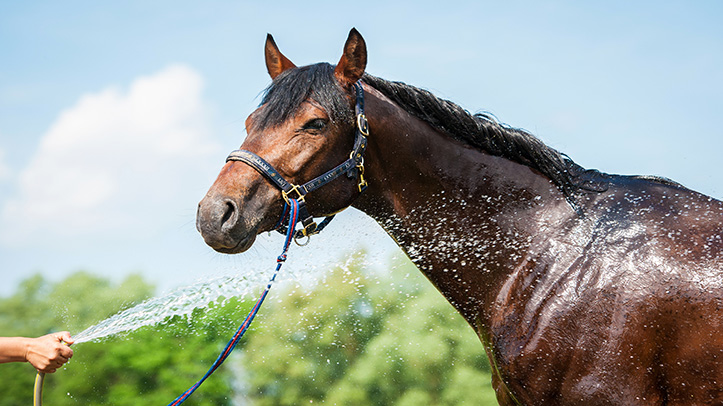
    With another sizzling summer on the cards, the nutrition advisors for the SPILLERS brand are sharing their guidance on keeping equine digestive systems healthy in hot weather, with appropriate hydration and forage intake.

    “The average 500kg horse on an all-hay diet may drink 40 litres of water per day and a horse exercising in hot weather, can lose as much as 10-15 litres of fluid per hour through sweating,” said Sarah Nelson, product manager at Mars Horsecare, home of the SPILLERS brand.

    “Dehydration can impair performance, poses several health risks and in severe cases it can be fatal. Hot, dry weather may also heighten the water soluble carbohydrate content in grass and increase the risk of laminitis, while sparse pastures may increase the risk of sand colic.”

    Ms Nelson offers 11 practical tips that SQPs can pass on to horse owners, so their horses beat the heat safely this summer.

    Keep water supplies fresh, clean and plentiful
    Fresh grass contains around 80% water. Under normal circumstances it may go a long way in meeting requirements but when soaring temperatures have scorched the grass, intake from buckets and troughs could more than double so make sure clean fresh water is always available.

    Check automatic troughs are working and keep an eye on herd dynamics – older or less dominant horses may be prevented from accessing water.

    Monitor fluid intake
    If you are concerned about fluid intake, try using manually filled buckets and troughs in hot weather so that you can monitor drinking easily.

    Tempt reluctant drinkers
    Horses may be reluctant to drink when they are away. They may prefer to drink familiar water from home so where possible try taking water with you to shows. It may also help to train your horse to drink flavoured water, perhaps by adding apple juice or molasses but if you are competing always consider the risk of prohibited substances before choosing a flavour. If offering flavoured water always offer plain water as an alternative.

    Count droppings to assess forage intake
    Although your field may look bare, if your horse or pony is overweight and you are picking up a similar number of droppings feeding additional forage may not be necessary.

    Yellow grass may not look particularly appetising but if there is enough available it will have a similar energy level to hay which is more than enough to sustain many horses. 

    Support hydration by using a soaked feed
    Using soaked feeds is a great way of getting extra fluid on board via the feed but an added benefit is that horses fed mashes may drink more too. Soaked feeds may be especially useful for those who are fussy drinkers.

    Don’t prepare soaked feeds in advance
    Soaking feeds in advance in hot weather can cause them to ferment quickly which is not desirable. Instead choose a fast-soaking mash – some take less than five minutes to prepare.

    Avoid soaking hay for more than three hours
    Soaking causes a rise in microbial contamination that may be exacerbated in hot weather. If soaking to reduce the ‘sugar’ content, we recommend 1-3 hours in warm weather and 6-12 hours in cold weather. If soaking to reduce ‘dust’ just 10 minutes may be sufficient.

    Beware scorched grass may be high in WSC
    Whilst drought and overgrazing inhibit growth, grass continues to produce sugar in sunny conditions. When it can’t be used for growth, this sugar is stored in the stem as fructan which means scorched grass may still be high in water soluble carbohydrates (WSC: includes simple sugars and fructan), presenting a hidden danger for laminitics. 

    Avoid sand colic
    The risk of colic from eating sand or soil is much higher if grass coverage is very sparse. Consider feeding hay or a low-calorie hay replacer, ideally in a net, feeder or bucket rather than from the ground.

    Provide a salt lick
    The recommend amount of compound feed or balancer, suitable forage and access to an equine salt lick will generally meet electrolyte requirements for maintenance. For those sweating on a regular basis, table salt (the salt you put on your chips!) is often an effective way of providing additional sodium and chloride.  

    Take care when the rain arrives!
    When the rain inevitably arrives, there will be a rapid increase in grass growth and consequently intake, increasing the risk of laminitis, weight gain and colic. Access to grazing may need to be restricted for good doers or removed completely for those at very high risk of laminitis.

    SPILLERS Perform & Restore Mash
    Feeding SPILLERS Perform & Restore Mash supports hydration and helps to replace some of the electrolytes lost through sweating. It is high in fibre and low in starch and sugar to support digestive health and reduce the risk of excitability.

    Share. LinkedIn Facebook Twitter Email
    Previous ArticlePets at Home begins share buyback programme
    Next Article Purina Institute launches Canine and Feline clinical nutrition handbook for vets
    mm
    Simon King

    Editor - Over The Counter. Simon has more than 20 years’ experience in B2B publishing. When not slumped over his PC, Simon is a keen follower of sport, supporting Manchester United, and is at his absolute happiest watching most sport in glorious UHD, with something cold to drink by his side.

    Read Similar Stories

    New film warns of potential resurgence of dangerous large redworm in UK horses

    Vetpol to host four equine CPD webinars

    International welfare champion wins NEF Sir Colin Spedding Award

    Most Read

    Farms hold key to break rodenticide resistance spread

    June 3, 2026

    New calculator helps optimise pig and broiler feed strategies

    June 2, 2026

    New environmental index launched to cut UK sheep flock carbon footprint

    June 1, 2026

    Any animal medicine advertising or promotion should conform to the ‘code of practice’ of the National Office of Animal Health (NOAH).
    For full details contact the publisher or www.noah.co.uk.

    Lewis Business Media Ltd endeavours to make articles and statements as accurate as possible.

    © 2026 Lewis Business Media. All Rights Reserved.
    Lewis Business Media, Suite A, Arun House, Office Village, River Way, Uckfield, TN22 1SL

    Privacy Policy | Cookie Policy | Terms & Conditions

    The OTC "tick" mechanism is the copyright of Lewis Business Media Ltd ©2025

    • Pet Business World
    • Pest

    Type above and press Enter to search. Press Esc to cancel.

    OvertheCounter
    Managing Your Privacy

    To provide the best digital experience, we use cookies to store and/or access device information. Consenting to our use of cookies allows us to process data such as reading behaviour. Not consenting or withdrawing consent, may adversely affect certain features and functions.

    Functional Always active
    The technical storage or access is strictly necessary for the legitimate purpose of enabling the use of a specific service explicitly requested by the subscriber or user, or for the sole purpose of carrying out the transmission of a communication over an electronic communications network.
    Preferences
    The technical storage or access is necessary for the legitimate purpose of storing preferences that are not requested by the subscriber or user.
    Statistics
    The technical storage or access that is used exclusively for statistical purposes. The technical storage or access that is used exclusively for anonymous statistical purposes. Without a subpoena, voluntary compliance on the part of your Internet Service Provider, or additional records from a third party, information stored or retrieved for this purpose alone cannot usually be used to identify you.
    Marketing
    The technical storage or access is required to create user profiles to send advertising, or to track the user on a website or across several websites for similar marketing purposes.
    • Manage options
    • Manage services
    • Manage {vendor_count} vendors
    • Read more about these purposes
    Cookie Preferences
    • {title}
    • {title}
    • {title}