

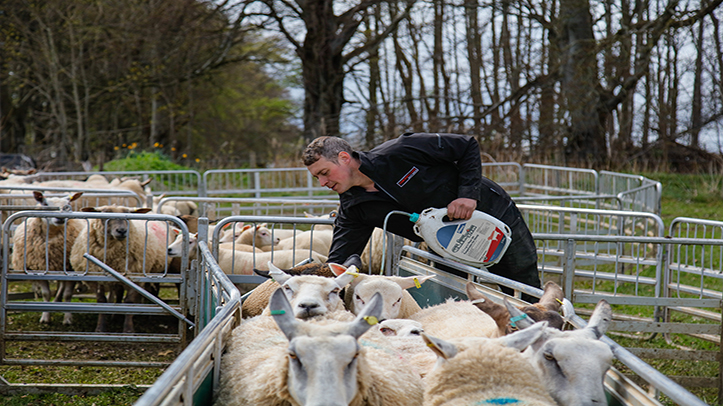
Elanco Animal Health said a recent survey found that 70% of UK sheep farmers have seen cases of blowfly strike prior to shearing, highlighting the need to consider earlier application of preventative treatments.
The survey, designed to understand the parasite pressures facing sheep farmers amid changing weather patterns, suggests blowfly activity is beginning earlier than it was five years ago.
Carolyn Hogan, ruminant technical consultant at Elanco, said Met Office data shows a general trend towards increasingly milder weather, with temperatures this March being above average. “Our aim was to understand how this shift in weather might be influencing when farmers are seeing parasites on farm,” Ms Hogan said
“The results corroborate the fact that blowfly emergence is happening earlier than it has in the past, with reports of strike as early as March and April in some regions.”
Ms Hogan said the pre-shear period is high risk for sheep with full fleeces, particularly when the weather is mild and wet.
This was reflected in the survey where results showed a large proportion of farmers across the UK have seen cases of strike in ewes before shearing.
“Blowfly emergence is driven by temperature. Once the temperature rises above 9oC, flies begin to accumulate what we call degree days,” Ms Hogan said.
“Warmer conditions accelerate the accumulation of these degree-days, meaning that with higher temperatures earlier in the season, we’re seeing blowfly emergence sooner than in previous years.”
To help mitigate the risk of struck sheep, Ms Hogan recommended an early application of an Insect Growth Regulator (IGR).
“Blowfly strike can be costly for farmers and just one struck sheep is one too many, so applying a preventative treatment before blowflies become a problem can help reduce this risk and also limit the number of flies reproducing throughout the season,” she explained.
“If you’ve got ewes and lambs in for treatments post-lambing then it’s worth considering an IGR application for your ewes at the same time, to provide cover from blowfly strike during the pre-shearing period when they are particularly vulnerable.
“CLiKZiN is an ideal choice as it offers eight weeks’ protection – often enough to cover ewes ahead of shearing – after which a longer-duration product such as CLiK Extra can be used after shearing to protect sheep through the main summer period.”
She added: “CLiKZiN has a meat withdrawal of just seven days, making it a suitable option for fat lambs too.”
Ms Hogan said while treatment timing and product choice are important, correct application will ensure you get the most out of preventative treatments.
“When using products from the CLiK range, following the four-stroke application method will help you to get optimal results,” she said.
“Also, calibrating your dosing gun ensures that the right amount of product is applied, reducing waste and allowing you to get the most from each application.”