

Three-year collaborative research project between Cogent Breeding and Kite Consulting on four commercial dairy farms proves valuable role of genetics in feed efficiency, profitability and sustainability.
With feed being one of the biggest costs on farm, both financially and considering its contribution to the farm’s carbon footprint, selecting for higher feed efficiency as a secondary selection criteria to breeding objectives can have a positive impact on profitability and sustainability, new trials have shown.
The Ecofeed feed conversion efficiency index, which was introduced by Cogent Breeding in 2017, identifies animals with the genomic trait who do more with less, using fewer feed resources to produce milk. The index enables producers to select the most profitable cows and heifers with high feed conversion efficiency to breed from, improving overall farm performance and returns.
The research project took place over three years, from 2020-2023, and was led by Kite Consulting’s head of genetics Rose Jackson.
Four family-run Derbyshire and Staffordshire dairy farms, milking either twice or three times per day, took part in the trial. Herd sizes range from 180 – 500 cows, and are all predominantly housed.
Alongside demonstrating the role of genomics in improved genetic gain and performance, the project aimed to establish a baseline for Ecofeed scores across the four Arla member farms, and quantify the potential for increasing the Ecofeed scores during the three-year trial period.
Using a combination of genomic testing and a strategic sexed breeding strategy, the four trial farms all made significant gains in both genetic potential for milk solids and actual total solids production in analysis from 2020 – 2023.
Using Cogent’s PrecisionMAP breeding programme and reporting tool, genomic tested females from each farm were analysed relative to the Ecofeed trait and each farm’s £CCI – Cogent’s unique Cogent Customer Index, which is based on £PLI (Profitable Lifetime Index), but also weighted to each farm’s milk contract.
All farms in the project are Arla farmer members on components contracts, so milk solids were a key focus, alongside the Ecofeed trait.
The breeding programme used female sexed dairy semen on all identified genetic elite females and Holstein bulls were selected on fat and protein, with all bulls scoring positive on the Ecofeed ranking.
“Ecofeed is a relatively new trait, and while lots of work has gone into its development, we were keen to study this over a period of time in a commercial setting,” said Siôn Parry, genetic data analyst at Cogent.
Genetic progress was identified using two figures – £PLI and total milk solids.
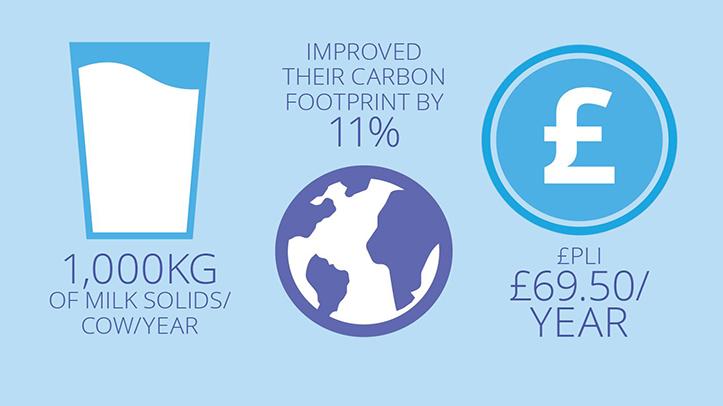
On average, the rate of genetic gain from Ecofeed genetics quantified by £PLI was £69.50/year over a 5-year period which is significantly higher than the UK average of £60/year.
Milk recording data shows that all four trial farms achieved or exceeded 1000kg/cow/year in milk solids in 2023 demonstrating a 19% increase compared to 2020. It is estimated that up to 50% of this improved output is down to genetics.
Comparing the whole herd to the 0-12 heifer group showed an average 51% increase in genetic gain for total milk solids (gPTA, genomic Predicted Transmitting Ability), meaning these heifers have 51% more potential to produce milk solids when they enter the herd compared to where the herd is currently.
“These were very different farms genetically as a starting point, so we had to first establish the baseline for Ecofeed,” explains Kite Consulting’s Rose Jackson.
Ecofeed is expressed relative to a baseline of 100, with scores over 100 meaning better feed efficiency. On average, the farms have improved by 3.8 Ecofeed points, which equates to a predicted DMI saving of 0.2kg/cow/day.
“This has been a great project to show how we can improve production efficiency through genetic gain,” Rose continues.
“Selecting on the cow and heifer side for the Ecofeed trait, these results show that it is possible to gain in Ecofeed whilst maintaining the genetic gain we already see in other commercially important traits. The results have been substantial, which could have a huge impact continuing on that trajectory.”
The research has also demonstrated that the Ecofeed trait can help contribute to improved Arla climate check scores, which in the UK averaged 1.13 in 2023. The trial farms improved their climate check score by 11% av., dropping from an average of 1.19 to 1.04.
“Feed efficiency, despite it being talked about for a while now, will become more and more important economically, and we have to use every tool we can to meet the industry target for carbon reduction. There’s no one answer, but Ecofeed genetics can certainly make a considerable contribution to this,” Siôn added.
“We should not underestimate the impact these advancements can make to the overall performance of the industry.
“At a challenging time, with fluctuating feed costs, and increasing pressure to reduce carbon output, this new approach to breeding offers a huge, and easily attainable, opportunity for dairy farmers to improve business performance.”