

Postal worm egg count specialists, Westgate Labs, is reporting a notable rise in worm egg count results through this autumn’s test results in UK horses.
The increase is thought to be linked to the unusually warm, dry summer weather, with experts recommending regular testing and poo picking as the first line of defence to protect horses from this increased risk of parasite infection.
Many owners carrying out their routine autumn tests were surprised to see higher counts than expected, with horses that had previously shown low or clear results now presenting with medium or even high readings despite no change in management.
It’s thought that the relatively high temperatures in summer combined with intermittent rain may have provided ideal conditions for larvae to develop and survive on pasture, leading to infection and, subsequently, higher levels of egg shedding.
The stats
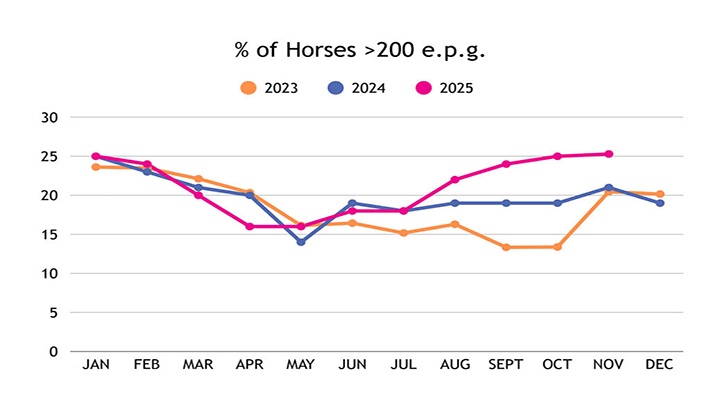
The monthly summary of equine worm egg count results for 2025 shows a higher proportion of horses shedding more strongyle eggs compared with previous years. In September, 13.34% and 19.42% of worm egg count results were above 200 eggs per gram (epg.) in 2023 and 2024 respectively, rising to 24.12% in 2025.
A similar pattern was seen in October, with 13.44% of tests above 200 epg. in 2023, 19.18% in 2024, and 25.04% in 2025. Egg shedding stayed high November 2025 with 25.29% above the threshold, compared to 20.46% in 2023 and 20.56% in 2024.
The threshold of 200 epg. is important, as it marks the level at which treatment is indicated for most healthy adult horses within a targeted parasite control programme.
Statistical testing indicates that the increase is not yet significant, but the upward trend is notable and will continue to be monitored as more data becomes available later in the year.
Influencing factors
Professor Jacqui Matthews, a recognised specialist in parasitology and director of Veterinary Science at Austin Davis Biologics, said: “What we’re likely seeing is the impact of a warm summer allowing the larval development phase to speed up, meaning horses can become more readily infected as they graze.
“There’s also been less forage available, so horses have been cropping the grass closer to the soil and dung piles and there’s been less opportunity to rest and rotate grazing, further increasing infection potential.
“What this means for horse owners is that they need to be regularly testing all horses as even those with historically good results may be more at risk of worm infection than in previous years and prioritising poo picking.”
Westgate Labs’ director, Kristy Hodgson, echoed this advice.
“Alongside worm egg counts every 8–12 weeks, poo picking is our first line of defence in helping to combat parasite infection, physically breaking the life cycle by removing the eggs from the pasture,” Mrs Hodgson said.
“I chat to tens of horse owners every day and it’s consistently our customers who aren’t able to clear dung who have seen the biggest rise in the number of horses requiring treatment this autumn. The data reinforces the importance of pasture hygiene over harrowing, which in warm, damp conditions may spread larvae rather than destroy them.”
Mitigating the impact
Regular worm egg counts every season remain the cornerstone of good parasite control. Testing all horses every 12 weeks, alongside twice-yearly tapeworm testing, ensures targeted treatment and helps avoid unnecessary worming that contributes to drug resistance.
Horse owners are recommended to risk assess their horses for parasite infection, using either the CANTER or What’s Your Worm Risk profiling tools and speak to their prescribers to decide on their approach to encysted stages of small redworm this autumn/winter.
Westgate Labs and Austin Davies Biologics are presenting a free webinar, focussing on redworm infection, at 7pm on Wednesday, January 14. To sign up click ‘going’ on the Facebook event page here.