

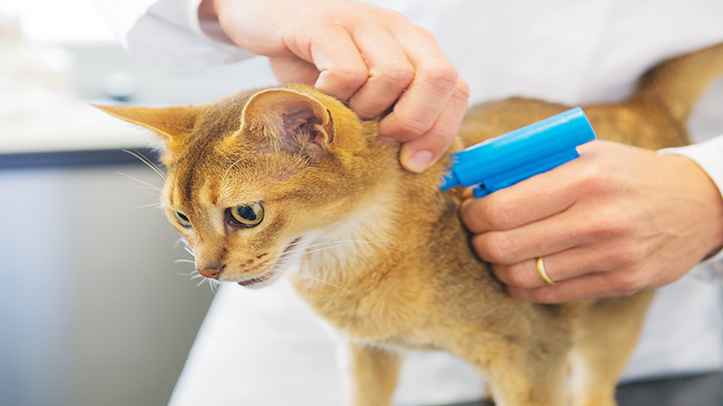
The Scottish SPCA is highlighting the importance of microchipping after obtaining new data that reveals alarming numbers of stray pets do not return home.
More than5,400 stray dogs have been handled by Scottish local authorities since 2020, with fewer than 700 having up-to-date microchip details.
The Scottish SPCA, in partnership with other animal welfare organisations, is calling on pet owners to microchip their cats and dogs – and keep their details up to date – as a simple yet vital step to keep pets and owners together.
Every year, thousands of stray animals are reported to Scottish local authorities and the Scottish SPCA, but without proper identification, reuniting them to their families can be extremely difficult.
The Scottish SPCA sent a Freedom of Information request to all 32 Scottish local authorities regarding their handling of stray dogs, and the results were shocking. Of the 29 authorities that responded on time, data showed that since 2020, they have handled 5,409 stray dogs.
However, only 2,065 of those dogs were microchipped, with just 656 having up-to-date owner details.
This significantly affects the chances of a reunion, with fewer than 60% being returned to their owners.
Similarly, from 2021 to 2025, the Scottish SPCA cared for 3,284 stray cats and dogs. Only 377 of these animals were microchipped, while fewer than 800 were reunited with their owners.
Jennie Macdonald, head of rehoming, fostering & community engagement, at the Scottish SPCA, said: “The volume off animals that we get into our care is extremely frustrating, as many of them could actually have an owner but have purely just got lost. We are not able to trace them due to the absence of a microchip, or it not having up to date details.
“We are also calling for a unified national pet microchipping database in the UK. At the moment we have to check multiple systems to see if the chip is registered.”
It is a legal requirement to microchip your dog in Scotland by the time it is eight weeks old. While it is not currently a legal requirement to microchip cats, Scottish SPCA strongly recommends it.
That is why the Scottish SPCA is calling for compulsory cat microchipping in Scotland, along with the introduction of a single, centralised database.
Microchipping is already part of the Society’s standard rehoming process for cats, and the charity is working with key stakeholders to push for changes that will improve cat welfare and safety nationwide.
Data shared by Cats Protection showed that more than 260,000 owned cats in Scotland are still potentially without a microchip. Surprisingly, of those who have chosen not to microchip their cats, 38% said it’s because they do not go outside.
However, owners must understand, indoor cats are arguably at greater risk of becoming disoriented and lost in the event of an accidental escape, so they would also benefit greatly from having a microchip.
Alice Palombo, advocacy & government relations manager at Cats Protection, said: “Microchips are a quick and permanent way of identifying a cat, helping to reunite lost, injured, or stolen cats with their loving families. Sadly, many of our pens are filled with friendly strays without a microchip.
“Trying to find the cat’s owner puts a burden on our teams and takes up space in our pens for cats that need us the most. When a cat’s family cannot be found the cat must be needlessly rehomed, leaving their family to possibly never find out what happened to their beloved pet.”
She added: “It’s disappointing to see microchipping rates continue to fall in Scotland and signifies that owners are not proactively microchipping their cats. Cats Protection is calling for the Scottish Government to introduce compulsory microchipping of pet cats to encourage responsible ownership and help reunite cats with their families.”