

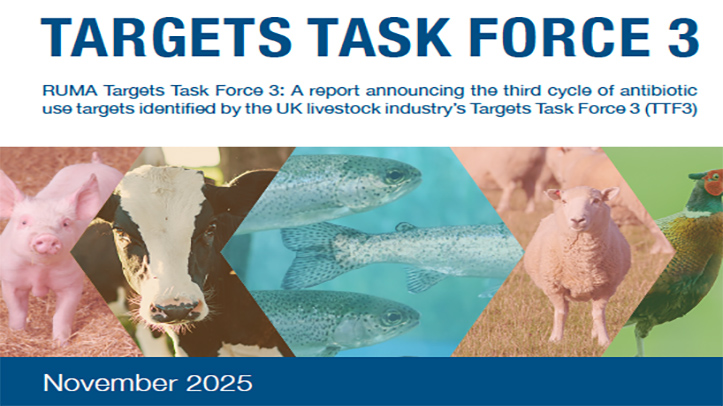
The Responsible use of Medicines in Agriculture Alliance (RUMA Agriculture) has today released the third cycle of targets from its Targets Task Force (TTF3), which represents commitments from each livestock sector from 2025-2029 in line with the Government’s AMR National Action Plan.
The next cycle of RUMA Targets Task Force targets (TTF3), which have been endorsed by The Animals, Plants, Food and Environment Delivery Board for the UK AMR National Action Plan (NAP), marks another key milestone in the journey of this unique livestock industry initiative; one that has been applauded globally for the reductions in antibiotic use that have been achieved through a movement that has been based completely on voluntary industry collaboration, at all levels, to address AMR.
RUMA Agriculture chair, Cat McLaughlin, said: “As the TTF group enters its ninth official year in existence, there is much to be praised with what has been achieved to date including a 57% reduction in the use of antibiotics across UK livestock sectors and HP-CIA use is down by 83%.
“TTF3 continues to grow on these achievements and represents commitments from each livestock sector from 2025-2029 in line with the Government’s AMR National Action Plan.”
The newly released report contains a top-level summary of each sector’s TTF3 targets, plus an overview of the wider work underway on AMS activities, projects and campaigns, which will support the delivery of the targets throughout this third cycle of the TTF.
The key focus of the TTF group is to demonstrate the UK livestock industry’s commitment to tackling AMR and, where antibiotics are used in farm animals, that they are used responsibly.
Ms McLaughlin said: “It should be noted that there are several key factors that can affect the journey of the targets. For some sectors, sustainable levels of use may already have been reached and targets are being held from TTF2; this isn’t about being complacent, but there is a need for realism and understanding that in some cases, the journey ahead will be about maintenance of low use rather than pushing for further reductions which could have a detrimental impact on animal welfare.
“How the sectors demonstrate their commitment to responsible use varies based on the sector, its size, and their own unique challenges and infrastructures. Some sectors have the benefit of data which helps evidence progress and makes setting targets easier; for others, data is less available but the commitment and focus is still evident in TTF3, just demonstrated differently as can be seen by the work currently underway with the UK Ruminant Antibiotic Stewardship Roadmap. RUMA Agriculture has encouraged sectors to set targets which are relevant and can be properly measured and reported on.”
Ms McLaughlin continued: “Vaccine availability has also been and remains a challenge for some sectors and has the potential to affect antibiotic use moving forwards. RUMA Agriculture is pleased to see the recent publication of the Statement of Intent on UK Veterinary Vaccine Availability, by the Veterinary Medicines Directorate (VMD) which has demonstrated a commitment to working alongside the agriculture sector to support farmers having access to the vaccines they need.
“We are proud to have contributed to this strategic framework & look forward to working with the VMD on a five-year multi-stakeholder UK action plan that will turn these ambitions into reality.
“Other challenges include climate change, the impacts of which creates numerous challenges especially for those farming systems based outdoors. Finally, disease outbreaks such as Avian Flu, Bluetongue, and Schmallenberg, plus, new emerging diseases, all present new challenges to livestock sectors.”
During the next cycle of targets (TTF3), if new reporting metrics become available for the sectors which will help to further demonstrate their responsible use commitments, then these will be introduced if/as appropriate along the way.
For example, the ruminant sector is undertaking a key piece of strategic work to shape its future AMU commitments with the launch of the UK Ruminant Antibiotic Stewardship Roadmap; once this roadmap is complete, the targets for the ruminant sector are likely to be evolved and refined.
Abi Seager, chief executive at the Veterinary Medicines Directorate, said: “VMD welcomes the third set of targets, which reflect the sectors’ long-standing commitment to tackle AMR and continuing their journey of responsible antibiotic stewardship, since the establishment of the RUMA Targets Task Force in 2016.
“We look forward to the ongoing collaboration between industry and government to improve animal health and antibiotic stewardship.”