

OvertheCounter
    Twitter LinkedIn
    • Email Newsletters
    • Magazine Subscriptions
    • About Us
    • Advertise
    • Contact Us
    Twitter LinkedIn
    CPD Log-In
    OvertheCounter
    • News
      • Dairy / Beef
      • Sheep
      • Pigs / Poultry
      • Equine
      • Companion
      • Retail
      • Training
    • Magazines
      1. May 2026
      2. March 2026
      3. January 2026
      4. November 2025
      5. September 2025
      6. July 2025
      7. May 2025
      Featured

      Over the Counter – May 2026

      By Simon KingMay 18, 2026
      Recent

      Over the Counter – May 2026

      May 18, 2026

      Over the Counter – March 2026

      March 17, 2026

      Over the Counter – January 2026

      January 12, 2026
    • CPD Training
      • AMTRA CPD Modules
        • Frontline Academy
        • Companion Animal CPD Modules
        • Equine CPD modules
        • Livestock CPD Modules
        • Poultry CPD Modules
        • Are you a Gold Standard SQP?
      • VETPOL CPD Modules
        • Companion Animal CPD Modules
        • Equine CPD Modules
        • Livestock CPD Modules
        • Poultry CPD Modules
      • Earning CPD points with overthecounter.news
      • CPD Log-In
      • Wormstock 2023
    • National SQP Awards
    OvertheCounter
    News

    Free online SCOPS forecast will help producers deal with huge variation in disease risk this spring

    mmBy Simon KingFebruary 28, 2024No Comments3 Mins Read
    LinkedIn Twitter Facebook Email

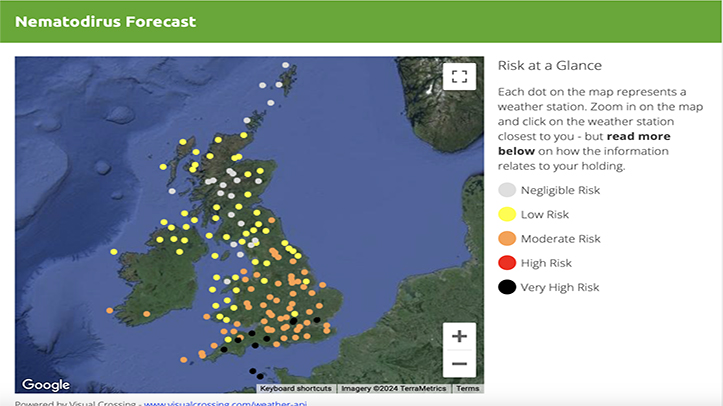
    Following a very wet winter and one of the warmest Februarys on record, experts in the Sustainable Control of Parasites in Sheep (SCOPS) group are predicting the threat to lambs from nematodirus will be extremely variable across the UK in 2024.

    Using the SCOPS Nematodirus Forecast at www.scops.org.uk/nematodirus will be really important to help prevent individual flocks being caught out, as well as checking the pattern of temperatures in recent weeks to decide if lambs are at risk.

    Lesley Stubbings, independent sheep consultant and SCOPS spokesperson, said: “A sudden increase in temperature after a period of cold weather can trigger a mass hatch of Nematodirus battus worms, from eggs that have laid dormant since the previous season.

    “If this coincides with the time when lambs are starting to take in significant amount of grass the result can be devastating. It can happen very quickly, so producers cannot afford to have a ‘wait and see’ policy, nor one that simply assumes the danger period will be the same every year.

    “Nematodirosis is caused by large numbers of immature larvae that lambs take in off pasture. These immature larvae are not producing eggs, so this is the one time of year when faecal egg counts (FECs) aren’t as useful. Instead, producers need to keep an eye on the forecast – which is a free, online resource – and consider their individual risk factors.”

    Nematodirus risk factors

    • Lambs are grazing pasture that carried lambs last spring;
    • Lambs are old enough to be eating significant amounts of grass;
    • Lambs are in groups where there is also likely to be a challenge from coccidiosis (e.g. mixed aged lambs);
    • Lambs are under stress (e.g. triplets, fostered, on a young or older ewes); and
    • A sudden, cold snap followed by a period of warm weather.

    The SCOPS Nematodirus Forecast is updated daily using data from 140 weather stations around the UK.

    Mrs Stubbings explained: “The colour-coded dots on the forecast provide a guide to the risk level in your area. Find the dot that is nearest to you or most representative of your farm. The height above sea level of each weather station is provided, as every 100m increase in altitude delays hatching by about seven days.

    “So, if your nearest station is at 200m above sea level but your farm is at 100m, for example, hatching could be around seven days earlier than the forecast. South-facing fields also tend to have an earlier hatch.”

    Although FECs are not useful for monitoring the nematodirus risk level, SCOPS does still recommend using FECs. They will help monitor other roundworm species and, if they identify nematodirus eggs, this can indicate what the level of contamination (numbers of nematodirus eggs) is going onto a pasture and, therefore, how risky they will be next spring and which areas to try to avoid if possible.

    Share. LinkedIn Facebook Twitter Email
    Previous ArticleMole Valley Farmers launches ‘breakthrough’ calf formula
    Next Article Jollyes secures investment to supercharge its next phase of growth
    mm
    Simon King

    Editor - Over The Counter. Simon has more than 20 years’ experience in B2B publishing. When not slumped over his PC, Simon is a keen follower of sport, supporting Manchester United, and is at his absolute happiest watching most sport in glorious UHD, with something cold to drink by his side.

    Read Similar Stories

    Farms hold key to break rodenticide resistance spread

    New calculator helps optimise pig and broiler feed strategies

    New environmental index launched to cut UK sheep flock carbon footprint

    Most Read

    Farms hold key to break rodenticide resistance spread

    June 3, 2026

    New calculator helps optimise pig and broiler feed strategies

    June 2, 2026

    New environmental index launched to cut UK sheep flock carbon footprint

    June 1, 2026

    Any animal medicine advertising or promotion should conform to the ‘code of practice’ of the National Office of Animal Health (NOAH).
    For full details contact the publisher or www.noah.co.uk.

    Lewis Business Media Ltd endeavours to make articles and statements as accurate as possible.

    © 2026 Lewis Business Media. All Rights Reserved.
    Lewis Business Media, Suite A, Arun House, Office Village, River Way, Uckfield, TN22 1SL

    Privacy Policy | Cookie Policy | Terms & Conditions

    The OTC "tick" mechanism is the copyright of Lewis Business Media Ltd ©2025

    • Pet Business World
    • Pest

    Type above and press Enter to search. Press Esc to cancel.

    OvertheCounter
    Managing Your Privacy

    To provide the best digital experience, we use cookies to store and/or access device information. Consenting to our use of cookies allows us to process data such as reading behaviour. Not consenting or withdrawing consent, may adversely affect certain features and functions.

    Functional Always active
    The technical storage or access is strictly necessary for the legitimate purpose of enabling the use of a specific service explicitly requested by the subscriber or user, or for the sole purpose of carrying out the transmission of a communication over an electronic communications network.
    Preferences
    The technical storage or access is necessary for the legitimate purpose of storing preferences that are not requested by the subscriber or user.
    Statistics
    The technical storage or access that is used exclusively for statistical purposes. The technical storage or access that is used exclusively for anonymous statistical purposes. Without a subpoena, voluntary compliance on the part of your Internet Service Provider, or additional records from a third party, information stored or retrieved for this purpose alone cannot usually be used to identify you.
    Marketing
    The technical storage or access is required to create user profiles to send advertising, or to track the user on a website or across several websites for similar marketing purposes.
    • Manage options
    • Manage services
    • Manage {vendor_count} vendors
    • Read more about these purposes
    Cookie Preferences
    • {title}
    • {title}
    • {title}